
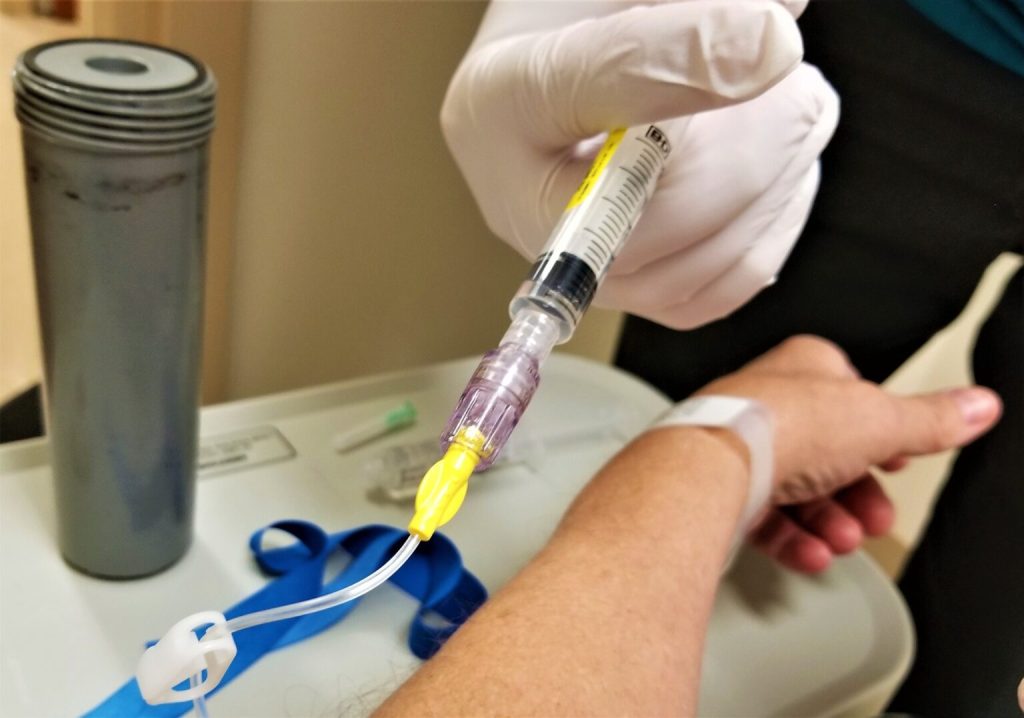
 Final Step – Delivery to the Hospital and Administration to the Patient
The last mile: where the supply chain finally meets the patient
Most medicines wait for the patient. A radiopharmaceutical does not.
Over the past six posts, we followed the value chain from source material acquisition and isotope enrichment through target preparation, irradiation, radionuclide processing and drug manufacturing. Six steps, all upstream, and all of them converge on a single dose, for a single patient, at a single point in time.
This last step is the least forgiving of the whole chain, because the clock starts the moment the radionuclide is produced. Decay cannot be paused and doses cannot be stockpiled, so a missed window is not a delay that inventory can absorb. It is product that no longer exists.
 Transport: the step that runs through all the others
Transport never appeared as a numbered step in this series because it is not one. It runs through every stage of the chain, and at the last mile it decides whether the patient is treated at all.
Half-life sets the geography of supply.
- 68Ga, at 68 minutes, travels very little. It is either eluted on site from a 68Ge/68Ga generator, in which case what ships is the generator itself with a shelf life of roughly a year, or produced on a cyclotron and distributed over short distances, much like FDG.
- 18F, at 110 minutes, supports local distribution from PET production centres within a few hours of the injection site.
- 99mTc, at 6 hours, moves as a 99Mo generator with a 66 hour parent, delivered weekly against a calibration date, with elution yield declining across the week.
- 177Lu, at 6.6 days, can be shipped internationally, but always against a calibration date agreed with the treatment centre.
- 131I, at 8 days, is routinely shipped across borders, supplied as capsules or as a solution depending on the indication.
- 225Ac, at 9.9 days, is not constrained by transport. Its limiting factor today is global production capacity.
Even then, the shipment is not a delivery in the ordinary sense. A dose is ordered as an activity at a stated calibration date and time, so the manufacturer dispenses with enough margin for the activity to still meet the prescription when the patient is on the table. Miss the slot and the vial is not late. It is no longer usable.
The regulatory envelope adds its own fixed cost in time. Most therapeutic shipments move as Type A packages under UN 2915, governed by International Atomic Energy Agency (IAEA) SSR-6 and, in Europe, by ADR on the road and the International Air Transport Association (IATA) Dangerous Goods Regulations in the air. Each package carries a transport index derived from the dose rate at one metre, which sets its category label and limits how many packages can share a vehicle or an aircraft hold. Class 7 is accepted by a limited number of carriers, and a customs hold of a few hours can consume the margin.
Which is precisely why the system is built around margin in the first place. Wherever it can, the industry adds buffer: extra activity at dispensing, earlier production slots, backup carriers and alternative routes. What it cannot do is hold stock. There is no shelf to draw a replacement from, so a lost dose means a new production slot and a new appointment for the patient, and for the shortest-lived products quality control and batch release run against the same clock as the shipment. Containers and shielding then travel back for reuse, while the waste stays with the hospital.
A delayed flight, in this context, is not a logistics KPI. It is a cancelled treatment slot.
 The receiving end: turning a delivered dose into a treatment for the patient
But a dose that arrives on time is still only a dose. The treatment centre has to receive it, prepare it, administer it and follow the patient afterwards, all inside the same window.
 It requires physical infrastructure, from reception and controlled storage to shielded preparation areas and hot cells, with shielded patient rooms for some therapies depending on national rules.

 It requires people: nuclear medicine physicians, radiopharmacists, medical physicists, technologists, nurses and radiation protection officers. This is the team that absorbs every schedule variation, and in several regions its availability is already the binding constraint.
 It requires imaging, because companion imaging drives patient selection, dosimetry and follow-up. PET and SPECT slots are therefore part of the delivery chain rather than a separate service.
 It requires waste management, with decay storage and disposal rules that vary by radionuclide, half-life and national radiation protection framework. The impurity profile matters here as well, since carrier-added and no-carrier-added 177Lu do not leave the same long-lived waste burden behind them.
 It requires a regulatory path, since implementation sits at the intersection of pharmaceutical and radiation protection law, and requirements differ significantly between countries.
 And it requires money, because reimbursement pathways and hospital budgets ultimately decide how many treatment slots actually exist.
None of this can be improvised on the day a dose arrives.
 The Challenge Ahead
For years, the industry concentrated on securing the upstream: reactors and cyclotrons, enrichment capacity, targets and GMP manufacturing networks. That work continues and remains essential, but the constraint is no longer only upstream. It now sits on both sides of the chain at once.
And the three sides scale the same way. Production capacity is a question of capital and engineering. Logistics is largely a question of capital too, in drivers, vehicles, routes and shielded containers. Hospital capacity is capital again, in rooms, equipment and above all in people, who take the longest to train.
None of the three works alone. A production line running at full capacity into a hospital network that cannot absorb the volume treats no additional patient, and the reverse is equally true. The scaling has to happen everywhere at once, on the industrial side, on the hospital side, and in the logistics that connects them.
 The Big Question
Which makes the real question a question of financing.
Private capital is clearly no longer hesitant. On 3 August, Curium Pharma agreed to acquire Lantheus in a transaction worth up to 8 billion dollars. The same day, BWX Technologies agreed to sell its medical business, including BWXT Medical and Kinectrics‘ stable medical isotopes activity, to Nordic Capital for up to 800 million dollars, while retaining a minority stake. Both buyers are private equity backed, and between them the two deals span the chain from isotope production to commercial delivery.
But private capital funds companies. It does not fund nuclear medicine departments, shielded rooms or the training of medical physicists.
So where does the public funding come from, and who coordinates it with the private investment already flowing?
Thank you for following this series on the radiopharmaceutical supply chain.
Join the discussion in the comments 
#MEDraysintell #Radiopharmaceuticals #NuclearMedicine #SupplyChain #RadiopharmaceuticalLogistics #Radiopharmacy #PatientAccess