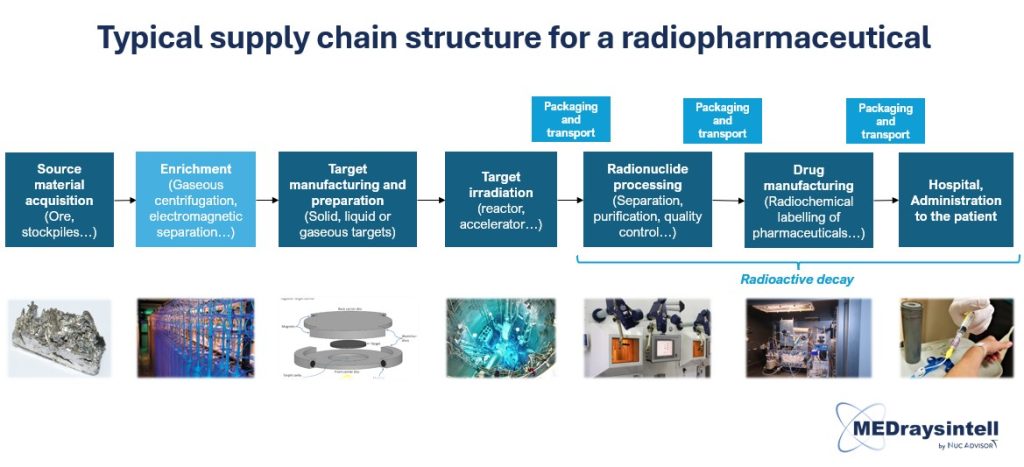
Over the next 7 weeks, we’ll take you inside each step of the radiopharmaceutical supply chain.
Radiopharmaceuticals play a critical role in modern healthcare, from cancer diagnostics to targeted therapies.
But behind every dose lies a highly complex, global, and time-sensitive supply chain.
From raw material extraction to patient administration, each step is tightly interconnected and vulnerable to disruption.
The key stages:
– Source material acquisition
– Isotope enrichment
– Target manufacturing
– Irradiation in reactors or accelerators
– Radionuclide processing
– Radiopharmaceutical production
– Delivery and hospital administration
Radioactive decay is often seen as the defining constraint of this industry and rightly so: time directly impacts product viability and patient outcomes.
In reality, nuclear licensing, raw material geopolitics, and international transport regulations (IATA, IAEA, ADR) make it just one constraint among many.
Focusing on decay alone doesn’t fully capture what is actually a highly constrained and deeply interconnected ecosystem.
At MEDraysintell, we help stakeholders better understand these interdependencies and anticipate risks across the value chain.
In this series, we will explore each step in detail: uncovering challenges, bottlenecks, and opportunities for optimization.
Which part of the supply chain do you think is the most critical?